Levoit Vital 100S: The CADR Number Doesn't Match the Registry
The middle Levoit tier - and the one we point bird owners toward first
4.3/5⚠ Spec overstated: manufacturer claims 195 CFM, registry shows 143Best for: a step up in CADR from the Core 300 without the Vital 200S’s price, or any household - cat, bird, or both - where a non-ionizing unit matters.
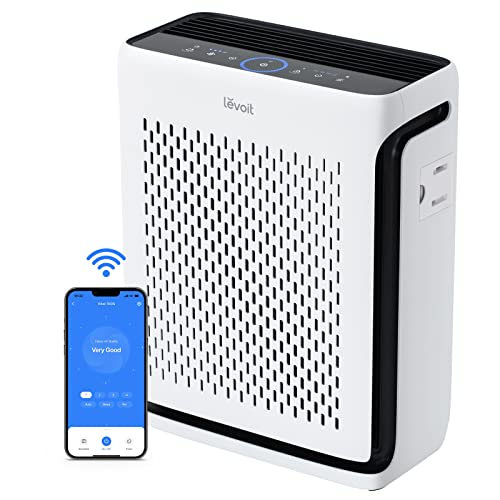
The Vital 100S occupies an odd position in Levoit’s lineup: it’s not the cheapest option (that’s the Core 300) and it’s not the flagship (that’s the Vital 200S), so the people buying it tend to have a specific reason rather than defaulting to “the mid one.” Two distinct buyer patterns show up for this model, and they don’t overlap much.
Two very different reasons people buy this exact model
The first pattern: someone outgrew a Core 300’s CADR - bigger room, an additional pet, more square footage than the budget tier comfortably covers - but didn’t want to pay for the Vital 200S’s washable pre-filter upgrade, which they didn’t feel they needed. The second pattern, and the more specific one: someone specifically searched for a non-ionizing purifier, usually because they keep a bird, and landed here because it’s the model most consistently recommended in bird-owner communities and on our own bird-specific guide for exactly that reason.
These are genuinely different buyers with genuinely different priorities, and it’s worth knowing which one you are. For a bird owner the point is the absence of an ionising mode; for a cat owner it is CADR headroom relative to the Core 300. Neither group cares much about what the other one is buying it for.
Why “no ionizer” matters beyond bird households too
Even if you don’t have a bird, the absence of an ionizing mode is a reasonable thing to want by default. Ionizers work by releasing charged ions that cause particles to clump and fall out of the air, and some models in that category produce trace ozone as a byproduct. There’s genuine debate about how much that matters for a household without a particularly sensitive respiratory system in it - but “genuine debate” is a reasonable thing to want to opt out of entirely rather than research, and a straightforward mechanical HEPA-plus-carbon unit like this one sidesteps the question altogether.
That’s a real, if understated, value proposition: fewer settings to get wrong, fewer features to research the safety of, one less thing to think about. It shows up less as a feature you notice and more as an absence of fiddling with anything ionizer-related - which, reading between the lines, is exactly what you’d expect from a feature that simply isn’t there to cause a problem.
CADR: the actual number that separates it from its siblings
At the AHAM-verified 143 CFM (Levoit’s own site lists 195 CFM), the Vital 100S’s 2/3-rule ceiling works out to roughly 215 sq ft - identical to the Core 300-P’s CADR number, which is worth noting directly: on raw airflow, these two models are actually tied, and independently tested at exactly the same number. The real difference between them is elsewhere (build, filter design, and a few feature details), not room coverage. For a genuine CADR step up, you’re looking at the Vital 200S’s AHAM-verified 250 CFM instead. The full breakdown of exactly where each tier’s numbers diverge is in our three-way lineup comparison.
What it costs to run
| Model | Role | CADR (CFM) | 2/3-rule room ceiling | Filter cost/yr | Filter life |
|---|---|---|---|---|---|
| Levoit Vital 100S-P | Pet-specific alt / Levoit mid | 143 | ~215 sq ft | $40-80 | 6-12 months |
| Levoit Core 300-P | Budget pick | 143 | ~215 sq ft | ~$60 | 6-8 months |
| Levoit Vital 200S-P | Best overall for cats | 250 | ~375 sq ft | $50-100 | 6-12 months |
The Vital 100S lands between its two siblings on yearly filter cost, tracking closely with its middle-of-the-lineup positioning generally - not the cheapest to maintain, not the priciest, no standout upgrade or compromise on the cost side specifically.
What owners actually report
- Bird owners are disproportionately specific in their reviews, frequently mentioning checking for an ionizer before buying and confirming its absence after - a level of spec-checking rigor that shows up less often in cat- or dog-focused reviews of other models.
- Cat owners who upgraded from a Core 300 report the CADR bump as noticeable but not dramatic - consistent with the math, since the two units share an identical CADR number; the reported improvement is more likely coming from a larger room fit or a second pet than the unit itself outperforming the Core 300 head-to-head.
- The lack of a washable pre-filter is the most common comparison point to the Vital 200S, mentioned by owners who researched both before buying and chose this one specifically for the lower price rather than being unaware of the tradeoff.
- Noise reports track closely with the Core 300 and Vital 200S - quiet and easy to ignore on lower speeds, more noticeable in a small quiet room on the top speed.
- A number of reviews mention running it alongside a Vital 200S in a different room - the 100S in a bedroom or office, the 200S in the main living space - rather than as a standalone whole-home solution.
What actually justifies paying more than the Core 300
Given the tied CADR, it’s a fair question to ask what the price premium is actually buying. Reading across both sets of reviews, it comes down to three things, none of them dramatic on their own: a build that a handful of owners describe as slightly more solid-feeling, a marginally lower yearly filter cost (see the table below), and - the one that actually drives purchase decisions specifically - the non-ionizing safety profile that matters disproportionately to bird owners. If none of those three specifically matter to you, the honest recommendation based on the data is to save the difference and buy the Core 300 instead; the airflow you’re paying for is identical.
A note on buying this specifically for a mixed cat-and-bird household
This is a common enough scenario to call out directly: households with both a cat and a bird, where the purifier needs to be safe for the bird but the primary daily complaint (litter smell, shedding) is cat-driven. The Vital 100S handles this reasonably well - its HEPA and carbon stages work the same regardless of which pet’s dander or odor they’re processing - but it’s worth setting expectations that it isn’t purpose-built around cat litter odor the way the carbon-forward Winix 5520 is, nor around cat hair the way the washable-pre-filter Vital 200S is. It’s a safe, capable generalist for a mixed household rather than a specialist for either pet.
Video review
Independent video review by HouseFresh

Levoit Core 300-P
4.4/5Honest downsides
- No washable pre-filter, the same tradeoff as the Core 300 - hair and dander management relies on the standard replacement schedule rather than a sink rinse.
- The CADR is genuinely tied with the cheaper Core 300, which means the price premium is paying for other details (build, feature set) rather than raw airflow - worth confirming that’s actually what you’re shopping for.
- No smart app or auto-mode on this tier - you set the fan speed manually.
- It’s easy to overbuy this for a small single-cat room where the cheaper Core 300 would perform identically on the coverage math.
A realistic first-week setup
- Confirm which buyer you are - CADR step-up from a Core 300, or specifically shopping for a non-ionizing unit - since it changes what “success” looks like for your purchase.
- Measure the room against the roughly 215 sq ft ceiling, the same as the Core 300’s.
- Place it near the main dander or dust source - a cat’s favorite spot, or a few feet from a bird cage per our placement guide if that’s the use case.
- Set a filter-check reminder around month 5-6 in a pet household, sooner than the full listed range if shedding is heavy.
- Double-check there’s no ionizing mode hiding in a settings menu if avoiding it was the reason you bought this model in the first place - it’s a genuinely simple confirmation, but worth doing once rather than assuming.
Alternatives worth knowing about
- If you don’t specifically need the non-ionizing feature, the Core 300 has essentially identical CADR at a lower price.
- If hair and dander from more than one cat is the bigger concern, the Vital 200S’s washable pre-filter and higher CADR are worth the step up.
- Trying to place this exact model against both siblings at once? Our full three-way comparison covers the specific crossover points.

Levoit Vital 200S-P
4.6/5Browse the full cat air purifier hub for every guide in this silo, or the bird air purifier hub if a non-ionizing unit for a bird household is what brought you here.
Frequently asked questions
What actually separates the Vital 100S from the Core 300 and Vital 200S?
CADR and pre-filter design, mainly. The Vital 100S sits between the two on both - more airflow than the Core 300 with a similar non-washable pre-filter, less airflow than the Vital 200S without its washable pre-filter upgrade. See our full three-way comparison for the exact numbers.
Is this the same unit recommended for bird owners?
Yes - it's the model we point bird owners toward specifically because it has no ionizing mode and no ozone-generating feature, just mechanical HEPA and carbon filtration. That safety profile happens to make it a solid, unremarkable-in-a-good-way choice for cat owners too.
Is it worth the price step up from the Core 300 if I only have one cat?
For most single-cat households in a small-to-medium room, the Core 300 is arguably the more efficient choice - the Vital 100S's extra CADR headroom matters more once a room gets larger or a second pet enters the picture. Owners with a single cat in a compact space more often report the 100S as more capacity than they end up using.
Does it have a washable pre-filter like the Vital 200S?
No - that's the Vital 200S's specific upgrade over both the Core 300 and the Vital 100S. The 100S sits in between on CADR but shares the Core 300's non-washable pre-filter design.