Do Air Purifiers Help with Dog Hair?
Quick answer: yes, for hair and dander that’s actively floating in the room air - but volume changes the math more than most people expect. A shedding, double-coated dog sheds dramatically more hair and undercoat by weight than a typical cat, especially during seasonal “coat blow,” which clogs a standard pre-filter faster and means CADR headroom matters more here than in a lighter-shedding household. Based on manufacturer specifications and how activated carbon and HEPA media work, the right purifier meaningfully reduces airborne hair and dander - it does not replace brushing or vacuuming.
A short-haired beagle is a relatively light shedder as dogs go, and the picture changes with Huskies, Labs, and German Shepherds to understand what actually changes when shedding volume goes up. The short version: the physics of what a purifier catches doesn’t change, but the maintenance cadence and the size of unit you actually need both do.
What “helps with hair” actually means
A HEPA filter captures particles down to 0.3 microns with high efficiency, which covers essentially all airborne dog hair fragments and dander flakes - the fine stuff that stays suspended in the air rather than immediately falling to the floor. That’s a genuinely different category from the hair you can see: the visible strands and tumbleweeds that collect along baseboards and on furniture settle out of the air relatively quickly on their own, purifier or not, and need to be vacuumed, brushed away, or lint-rolled at the source.
Where a purifier earns its keep is the invisible layer - the fine dander and micro-fragments of hair that stay airborne for extended periods, settle as a dusty film on dark surfaces (TV screens, shelving, countertops), and are what most owners are actually describing when they say a room feels “cleaner” after running a purifier for a few weeks. It’s a real, measurable effect on air quality; it’s just not the same thing as a hair-free couch.
Why shedding volume changes what unit you need
This is the detail that’s genuinely different for dogs versus cats, and it’s mostly about scale. A double-coated breed (Huskies, German Shepherds, Golden Retrievers, and similar) carries a dense undercoat that gets shed in bulk during seasonal transitions - “coat blow” - rather than a steady trickle year-round. During those windows, the sheer volume of loose hair and undercoat passing through a purifier’s intake can be dramatically higher than what a typical cat household produces, and that volume has to get through the pre-filter stage before the HEPA and carbon layers ever see clean air to work with.
A pre-filter that’s perfectly adequate for a light-shedding household can visibly clog within a couple of weeks during a heavy-shedding one, and once it’s clogged, airflow drops and the whole unit does less work even though it sounds like it’s running normally. This is why CADR headroom and pre-filter design matter more in a dog household than the room-size math alone would suggest - sizing to the room isn’t enough if the room also contains a seasonal hair-volume spike the manufacturer’s rating didn’t really account for.
Why a washable fabric pre-filter is the feature to look for here
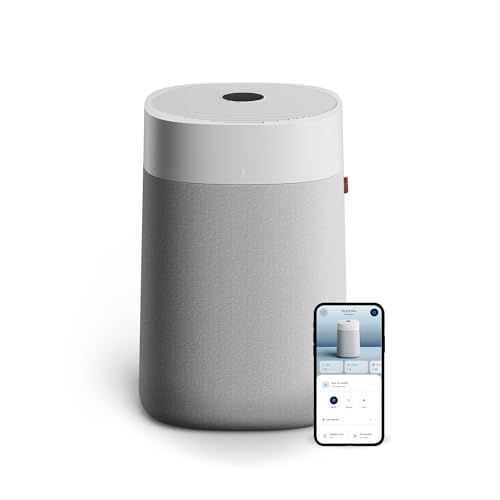
The Blueair Blue Pure 211i Max’s pre-filter is a washable fabric wrap around the unit - a genuinely different design from the washable foam pre-filter on Levoit’s Vital 200S-P, which we also cover in our multi-cat guide. Both designs solve the same underlying problem (letting an owner clear accumulated hair without buying a new pre-filter every few weeks), but the fabric wrap format on the Blueair has an edge for heavy-shedding dog households specifically: it can be vacuumed in place between full washes, which owners consistently describe as a faster maintenance step than removing and rinsing a foam insert, especially during a coat-blow season when it needs attention more than once a week.
Paired with the 211i Max’s AHAM-verified 435 CFM CADR - noticeably higher headroom than most cat-oriented models in this lineup - it’s the pick to lead with for a shedding, double-coated dog in a mid-to-large room, or for any multi-pet household where hair volume compounds across animals.
Dog dander and the allergy angle
For readers specifically weighing this against allergy symptoms: dog dander carries a specific protein (Can f 1) the way cat dander carries its own (Fel d 1) - different molecules, but similar behavior in the air. Both are attached to particles fine enough to stay airborne well after the visible hair has settled, which is part of why dander is arguably the more air-quality-relevant particle even though hair is what people notice first. A HEPA filter captures both at a similarly high rate; the practical difference for a dog household is mostly the higher overall particle volume during heavy shedding, not a difference in how well HEPA handles the dog-specific particle itself.
Where to actually put it
Placement matters more for hair capture than most people expect, for a simple reason: a purifier can only filter the air that reaches its intake. For a dog household, that means positioning relative to where the dog actually spends most of its day - a bed, a crate, a favorite spot by a window - rather than defaulting to “wherever there’s an open outlet.” A unit tucked in a corner far from the dog’s main resting spot is filtering air that’s already relatively clean while the actual hair-and-dander-heavy air near the dog goes largely untouched.
The same 2/3 rule used throughout this site applies here too: CADR (CFM) should be at least two-thirds of the room’s square footage for a meaningful number of air changes per hour. For a large-breed dog’s main living space - commonly 300-450 sq ft for an open living room or combined living/dining area - the 211i Max’s AHAM-verified 435 CFM comfortably clears that ceiling with room to spare, which matters more in a heavy-shedding household than in a lighter one, since it lets the unit run on a lower, quieter fan speed and still keep up rather than needing to run flat-out to compensate for an undersized rating.
A few placement specifics that matter: keep a few feet of open space around the intake rather than pushing the unit against a wall or under furniture, since restricted airflow reduces effective CADR regardless of the unit’s rated number; if the dog has one clearly preferred spot (a bed near a window, a corner of the couch), positioning the purifier within several feet of it does more for perceived air quality than centering the unit in the room geometrically; and in a multi-level home, a single unit downstairs does very little for a bedroom upstairs where the dog also sleeps - that’s a case for a second, smaller unit rather than expecting one large purifier to cover a whole house.
What owners actually report
- Less visible “tumbleweed” drift along baseboards is a commonly repeated observation, especially in homes running a purifier continuously rather than intermittently - loose hair still ends up on the floor, but noticeably less of it seems to travel across the room first.
- Reduced dust film on dark surfaces (TV screens, shelving) shows up often in multi-month reviews, tracking with the fine-dander capture rather than visible hair.
- Pre-filter maintenance frequency roughly doubles during shedding season for double-coated breeds compared to the rest of the year - owners of Huskies and similar breeds specifically mention weekly rather than monthly attention during spring and fall coat blow.
- “Still vacuuming just as much” is a common, expected comment, not a complaint about the purifier - it’s simply describing that settled hair and airborne hair are different problems, and the purifier was only ever going to help with one of them.
The honest limits
- A purifier does not remove hair already on furniture, carpet, or clothing - vacuuming and brushing still do that job.
- It doesn’t reduce how much a dog sheds; it only affects what becomes airborne after shedding happens.
- Results depend heavily on room size and placement - a unit undersized for a large open floor plan, or placed far from where the dog spends most of its time, does noticeably less than the same unit correctly sized and positioned.
- Seasonal coat-blow periods will still require more frequent pre-filter attention than the rest of the year, regardless of unit.
For the odor half of a dog household’s air-quality picture - a separate problem from hair, driven by skin oils rather than particles - see HEPA vs Carbon Filters for Pet Odors and the full system approach in How to Stop Your House Smelling Like a Dog. If you’re weighing this against a cat’s shedding load in the same house, our Do Air Purifiers Help with Cat Hair? guide covers the lighter-volume, washable-foam-pre-filter side of the same question.
Check Price on Amazon(paid link)Browse every guide in this silo on the dog air purifier hub.
Frequently asked questions
Does an air purifier stop dog hair from getting on furniture?
No. A purifier only affects hair and dander that's actively airborne - the fine fragments floating in the room air. Hair that's already settled on a couch, carpet, or clothing needs vacuuming, lint rollers, or brushing at the source; a purifier doesn't pull settled hair back off surfaces.
Why does dog hair clog a pre-filter faster than cat hair?
Mostly volume. A shedding double-coated dog sheds significantly more hair and undercoat by weight than a typical cat, especially during seasonal coat-blow periods, and that loose material has to pass through the pre-filter stage before the HEPA and carbon layers do any work. A pre-filter that's fine for a light-shedding household can clog within weeks in a heavy-shedding one.
Is dog dander the same kind of allergen as cat dander?
They're different specific proteins (Can f 1 for dogs, Fel d 1 for cats), but they behave similarly in the air - both are carried on very fine particles that stay airborne far longer than visible hair does, which is why dander is arguably the more relevant particle for air quality even though hair is what people notice first.
Do I still need to vacuum and brush if I run a purifier?
Yes. A purifier addresses what's floating in the room air. Brushing reduces how much hair and dander becomes airborne in the first place, and vacuuming removes what's already settled on carpet and furniture. All three do different jobs, and skipping any one of them means the others have to work harder.