HEPA vs Carbon Filters for Pet Odors
Quick answer: HEPA and activated carbon solve two completely different problems, and odor is almost entirely a carbon problem. HEPA filters trap particles - dust, dander, loose hair - using mechanical filtration. Activated carbon adsorbs gas-phase odor molecules using a completely different chemical process. A purifier can have an excellent HEPA rating and a strong CADR number and still barely touch litter box ammonia, wet-dog smell, or bird cage odor, because none of that comes down to how many particles it’s catching.
Variations of the same confused message arrive across every silo on this site - cats, dogs, birds - and it’s almost always the same root issue: someone bought a purifier based on the CADR number and the word “HEPA” on the box, ran it for a couple of weeks, and the smell in the room barely moved. The unit isn’t broken. It’s just doing the job it was actually built for, which turns out not to be the job the owner needed done.
What HEPA actually does - and why it stops at particles
HEPA (High Efficiency Particulate Air) is a mechanical filtration standard. Air gets forced through a dense mat of randomly arranged fibers, and particles get trapped by a combination of interception, impaction, and diffusion depending on their size. A true HEPA filter captures at least 99.97% of particles down to 0.3 microns - which covers litter dust, pet dander, loose fur fragments, pollen, and most household dust.
What it doesn’t do is interact meaningfully with gas-phase molecules. Ammonia from urine, the sulfur-containing compounds behind a lingering litter box smell, and the specific volatile compounds responsible for “wet dog smell” (largely bacterial and yeast byproducts from natural skin oils, which get released in much higher concentration when fur is damp) are all far smaller than 0.3 microns and behave like a gas, not a particle. They pass through HEPA media essentially unimpeded. A HEPA-only purifier can be running at full CADR in a room and be genuinely excellent at reducing visible dust while doing almost nothing for the smell in that same room.
What activated carbon does differently
Activated carbon works through adsorption, not filtration. It’s a highly porous material - usually carbonized coconut shell, though other sources exist - processed to create an enormous internal surface area (a single gram of activated carbon can have a surface area in the hundreds of square meters, once you count every pore). As air passes through it, odor molecules get physically trapped in that pore structure and held there, the way a sponge holds water rather than the way a sieve blocks rocks.
This is why an odor-focused purifier is a fundamentally different design problem than a dust-focused one. A HEPA filter mostly needs surface area facing the airflow. A carbon filter needs volume and density - a thin carbon layer has far less adsorption capacity than a thick one, even if both technically qualify for the phrase “activated carbon filter” on the box.
Why “activated carbon filter” on the label doesn’t mean much on its own
This is the detail that trips up almost everyone shopping by spec sheet. Nearly every pet-marketed purifier lists some form of “activated carbon” in its filter description, because it’s true in the loosest sense - there’s carbon somewhere in the stack. What the listing usually doesn’t make clear is whether that’s a genuinely thick, dedicated carbon stage, or a thin carbon-impregnated coating baked into the HEPA pre-filter as an afterthought.
The difference shows up fast once you know what to look for. A thin carbon layer works for the first few weeks and then saturates, which is why a unit can go from “smell is gone” to “worked great at first, now I can’t tell it’s running.” That pattern is carbon saturation. A thin layer reaches its absorption limit quickly and, unlike a HEPA filter (which keeps trapping particles until it’s physically clogged), a saturated carbon filter simply stops absorbing new odor - it doesn’t get less effective gradually, it more or less falls off a cliff once it’s full.
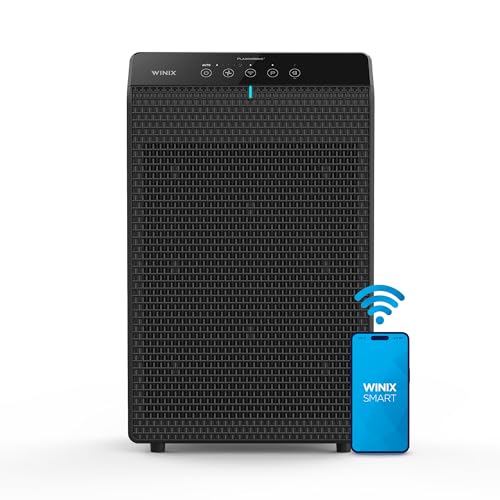
The Winix 5520 is a useful illustration of the alternative: its AOC (Advanced Odor Control) carbon stage is sized and marketed as a primary filtration component, not a bolt-on coating, and owners specifically cite that as the reason it holds up against ammonia-heavy litter box odor for close to its full rated filter life rather than tapering off early. Compare that with a more HEPA-forward design like the Levoit Vital 200S-P, which still performs well against odor thanks to a genuine carbon layer, but leans harder on its washable pre-filter and particle-capture strength as the headline feature. Neither is “better” in the abstract - they’re solving slightly different weighted versions of the same dust-plus-odor problem, and which one you want depends on which half of that problem is bigger in your house.
What each stage actually catches, across species
| Source | What it is | HEPA catches it? | Carbon catches it? |
|---|---|---|---|
| Litter dust, loose fur, dander flakes | Solid particles | Yes | Not its job |
| Litter box ammonia | Gas-phase odor compound | No | Yes |
| Wet-dog / skin-oil odor compounds | Gas-phase, bacterial/yeast byproducts | No | Yes |
| Bird cage dust, feather dander | Solid particles (often very fine, “powder down”) | Yes | Not its job |
| General “stale room” smell | Mixed, mostly gas-phase | Minimally | Yes |
The pattern that jumps out once you lay it out this way: dust and dander problems (heavier in bird and multi-cat households) lean on the HEPA stage, while wet, urine-, or bacteria-driven odor problems (heavier in dog and litter-box households) lean almost entirely on carbon. Most real households have some of both, which is why the best all-around units carry a genuinely balanced stack rather than maxing out one stage at the expense of the other.
Wet-dog smell is the clearest real-world example of this split
If you want the single clearest illustration of why this distinction matters, it’s a wet dog. A dog that’s been in the rain or just had a bath can make a room smell noticeably “doggy” within minutes, even though visually nothing has changed - no extra hair, no extra dust in the air. That’s because dampness dramatically accelerates the bacteria and yeast on the skin releasing more of those volatile odor compounds. A purifier with a strong HEPA rating and a weak carbon stage will do essentially nothing about that smell, because there’s no meaningful particle load driving it. It’s a pure carbon problem, start to finish - which is exactly why the buying advice for a dog household chasing odor specifically should prioritize carbon stage quality over CADR or HEPA-class marketing. Our full breakdown of what that looks like in practice, room by room, is in How to Stop Your House Smelling Like a Dog.
Hair and shedding volume are a different, particle-driven side of a dog household’s air-quality picture, and that side leans back on HEPA and pre-filter design instead - covered in Do Air Purifiers Help with Dog Hair?.
The same split shows up in litter boxes and bird cages
Cat owners run into an almost identical version of this problem with litter box smell - see Do Air Purifiers Get Rid of Cat Litter Smell? for the full mechanism, and Air Purifier for Cat Pee Smell for what changes when ammonia specifically is the dominant complaint rather than general litter dust. Bird households tend to skew the other way: cage dust and dander (especially from powder-down species) is a bigger factor than odor for most bird owners, which shifts the priority back toward HEPA and pre-filter design. The general pattern of “what actually helps with pet odor across species” is covered more broadly in Do Air Purifiers Help with Pet Odor?.
What to actually check before buying, if odor is your main complaint
- Don’t stop at “HEPA” in the name. Look specifically for a named, sized carbon or AOC-style stage described as its own component.
- Check the filter replacement interval against your actual odor load. A carbon filter rated for 12 months in a light-odor home may need replacing closer to 8-10 months in a heavier one - this is normal, not a defect, and it’s worth budgeting for rather than being surprised by.
- Weigh dust versus odor honestly. If dust and hair are your bigger complaint, a HEPA-forward design with adequate carbon is the right call. If odor specifically is the complaint, prioritize the carbon stage even if it means a slightly lower CADR number on paper.
- Placement still matters more than either filter type. No amount of carbon fixes a unit placed across the room from the actual odor source - proximity is a separate variable from filter chemistry.
Browse every guide in this silo on the dog air purifier hub.
Frequently asked questions
Can a purifier have great specs and still not fix odor?
Yes, and it's the single most common source of disappointed reviews across cat, dog, and bird households on this site. A high CADR number and a solid HEPA rating describe how well a unit moves and filters particles - dust, dander, loose hair. They say nothing about how much activated carbon is inside, which is the part that actually removes odor molecules.
Is 'HEPA filter' the same as 'odor filter'?
No. HEPA is a particle-capture standard - it traps things with physical mass, down to 0.3 microns. Odor compounds like ammonia and the sulfur- and bacteria-driven compounds behind wet-dog smell are gas-phase molecules with essentially no mass to trap. HEPA media doesn't meaningfully interact with them.
How do I tell a real carbon filter from a marketing one?
The honest signal isn't the phrase 'activated carbon filter' in the listing - nearly every purifier uses that phrase somewhere. It's whether carbon is a dedicated, visibly substantial layer (its own cartridge or a thick embedded layer you can see and feel) versus a thin carbon-impregnated coating on a HEPA pre-filter. The second type saturates fast and stops absorbing new odor well before the manufacturer's suggested replacement date.
Does a bigger CADR number make up for a weak carbon stage?
No. CADR describes airflow and particle removal rate, not odor-adsorption capacity. A unit can move a large volume of air through a thin carbon layer and still let most of the odor molecules pass through unabsorbed - moving more air faster through weak carbon doesn't fix the underlying limitation.
Do I need HEPA at all if odor is my only complaint?
Usually yes, because odor and particles are rarely fully separate problems in a pet home - litter dust, dander, and loose fur are often carrying some of that odor with them, and HEPA keeps the room from also looking and feeling dusty. But if odor alone is the primary complaint, the carbon stage is what should drive the buying decision, not the HEPA number.