Winix 5520: The Registry Number Is Higher Than the Box Says
Built odor-first, and it shows in nearly every review that mentions ammonia specifically
4.6/5Best for: ammonia-heavy litter box odor, especially in multi-cat homes where general HEPA-focused purifiers underperform on smell specifically.
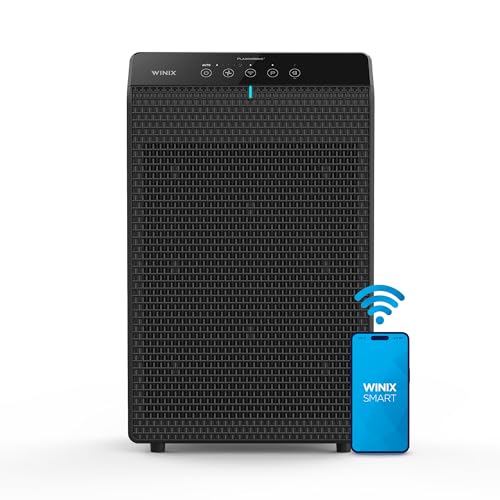
We have covered the Winix 5520 before as the answer to a specific question - ammonia-heavy cat pee smell. This piece steps back from that one use case and looks at the unit on its own terms: what its filter stages actually do, what the registry entries say, what it costs to keep running, and what the honest downsides are.
What this unit is built for: odor first, everything else second
Most purifier reviews, across most brands, are a grab-bag of comments about noise, app features, build quality, and effectiveness in roughly equal measure. The Winix 5520’s reviews are lopsided in a specific way: an outsized share of them are about smell, specifically, and specifically about ammonia. That’s not an accident of who bought it - it’s a reflection of what the AOC (Advanced Odor Control) carbon filter is actually built to do.
The mechanical reason this matters: ammonia is a gas-phase compound, not a particle. HEPA filtration - trapping particles as air passes through dense fiber mesh - does essentially nothing for it. The only thing that removes ammonia from air is adsorption onto activated carbon, and the amount of carbon, plus how directly air is routed through it, determines how much odor a unit can handle before the filter saturates. A lot of competing purifiers list “activated carbon” on the box while using a thin, carbon-dusted pre-filter as an afterthought to the HEPA stage. The 5520 is built the other way, and owners who’ve tried both categories are the ones who describe the difference most specifically in their reviews.
What the registry says about the CADR number
Winix’s own site lists 243 CFM for the 5520. The AHAM Verifide record for this exact model - listed under the model number “5520,” no ambiguity about which unit - shows a 253 CFM smoke CADR and a 392 sq ft room-size rating, both higher than Winix’s own marketing figures. Using the 2/3 rule, that AHAM-verified CADR works out to roughly 380 sq ft. It’s a small gap, and it runs the direction that doesn’t hurt you: the box undersells this one slightly rather than oversells it.
PlasmaWave: what it is, and why most owners just turn it off
The 5520 ships with an optional ionizing feature called PlasmaWave, switchable off entirely in the unit’s settings. It’s worth being direct about this rather than glossing over it: ionizers work by releasing charged ions into the air, and some models in this broader category produce trace ozone as a byproduct. That’s the reason we flag ionizing features specifically in our bird safety guide - the concern is more acute in bird households than in cat- or dog-only ones.
The practical takeaway is simple: PlasmaWave can be switched off permanently, and the odor control does not depend on it - the AOC carbon filter is doing the actual heavy lifting on ammonia regardless of whether PlasmaWave is on. Treat it as optional rather than as a feature worth seeking out, and you won’t be missing anything the carbon filter isn’t already providing.
The tradeoff nobody puts in the headline: no washable pre-filter
This is the detail that shows up in almost every review that compares the 5520 to a Levoit model, and it’s a real, honest tradeoff rather than a flaw. The Vital 200S has a washable pre-filter that owners rinse in the sink; the 5520 doesn’t have an equivalent stage, meaning cat hair and dander management leans more heavily on the standard filter replacement schedule.
In practice, this means the 5520 is the stronger pick when odor is your dominant complaint, and a HEPA-forward, washable-pre-filter unit is the stronger pick when hair and dander are the bigger issue. Plenty of households have both problems in roughly equal measure - which is exactly the case we walk through directly in our head-to-head comparison of the two models.
What it costs to run
| Model | CADR (CFM) | 2/3-rule room ceiling | Filter cost/yr | Filter life |
|---|---|---|---|---|
| Winix 5520 | 253 | ~380 sq ft | ~$80 | 12 months |
| Levoit Vital 200S-P | 250 | ~375 sq ft | $50-100 | 6-12 months |
| PuroAir 240 | 205 | ~308 sq ft | $162-216 · sub. $121-162 | 3 months |
The 5520’s filter costs slightly more per unit but lasts up to twice as long as some HEPA-forward competitors, which works out to a comparable - sometimes lower - effective annual cost depending on how heavily you run it. The PuroAir 240 is not a cheaper alternative on running cost, despite looking like one on paper - once you use PuroAir’s own 3-month replacement guidance rather than a longer estimate, it costs several times more per year to keep running than the 5520 does.
What owners actually report
- “The smell is just gone, not masked” is a specific, recurring phrase across reviews - owners drawing a deliberate distinction from products that rely on fragrance rather than actually removing the odor compound.
- Multi-cat households report the clearest before/after, likely because a heavier ammonia load makes the difference between a HEPA-focused unit and a carbon-focused one more obvious than it would be in a single-cat home.
- PlasmaWave-off is the common setting among owners who specifically mention it, usually alongside a note that odor control was unaffected by switching it off.
- The 12-month filter life holds up in lighter-use, single-cat homes, but multi-cat owners more commonly report replacing closer to 8-10 months to keep ammonia control at full strength.
- A faint “new unit” smell in the first day or two is normal, common to new electronics and fresh filter material, and it fades as the carbon stage settles in.
- The lack of a washable pre-filter is the most common point of comparison to Levoit models in reviews from owners who researched both before buying - mentioned as a tradeoff, not universally as a dealbreaker.
Noise, speed by speed
Winix publishes a 27-55 dB range across the 5520’s fan speeds, and what that means in a room depends on the speed you actually run. On the lowest one or two speeds it is a quiet, steady hum that’s easy to tune out within a day or two of ownership - several owners specifically mention forgetting it’s on until they check for airflow at the vent. The middle speeds are where most households actually run it day-to-day, described as present but unobtrusive, comparable to a box fan on low.
The top speed behaves the way it does on nearly every purifier on this site: in a small, quiet bedroom it is noticeable enough to bother a light sleeper; in a living room or open floor plan with normal background noise, the same setting goes largely unremarked. The practical takeaway from the reviews: auto mode or a lower manual speed for bedrooms, and reserve the top speed for a temporary boost right after scooping or for larger, noisier rooms.
Who this isn’t the right pick for
It’s worth being direct about the households where a different model serves better, based on what shows up in less enthusiastic reviews. If hair and dander - not odor - are your dominant complaint, the lack of a washable pre-filter means you’re on a stricter replacement schedule than a Levoit Vital 200S owner, and several reviews from heavy-shedding, multi-cat households specifically mention wishing for that feature. If your room is meaningfully larger than 380 sq ft, this isn’t the unit to stretch to cover it - a higher-CADR pick like the Blueair 211i Max is the better fit. And if brand-name ionizing features are something you specifically want to use rather than switch off, PlasmaWave here is a fairly basic implementation compared to some competitors that build their whole marketing pitch around it.
Video review
Independent video review by Hack and Learn

Levoit Vital 200S-P
4.6/5Honest downsides
- No washable pre-filter. Hair and dander management relies on the standard filter replacement schedule rather than a quick sink rinse - worth knowing if shedding is a bigger concern than odor in your household.
- PlasmaWave is an extra setting to check. It’s switchable, but that’s still one more thing to confirm is off if avoiding ionizing tech matters to you.
- At the AHAM-verified 253 CFM, it’s not the right choice for a room much larger than roughly 380 sq ft. Size up rather than expecting it to stretch further.
- Some owners note the footprint is slightly bulkier than similarly rated competitors - worth factoring in for tight spaces.
A realistic first-week setup
- Measure the room - confirm it’s under the roughly 380 sq ft 2/3-rule ceiling (253 CFM × 1.5) before assuming it’ll cover a larger open space.
- Place it within 3-5 feet of the litter box if ammonia is the primary complaint, angled so intake airflow passes near the box.
- Decide on PlasmaWave early - leave it off if you’d rather not think about it again; the carbon filter is doing the odor-control work either way.
- Give the carbon filter 24-48 hours to reach steady-state absorption before judging whether it’s working.
- Check the filter closer to the 8-10 month mark in multi-cat homes, rather than waiting for the full 12-month estimate.
Alternatives worth knowing about
- If hair and dander matter as much as odor in your house, our Levoit Vital 200S review covers the washable-pre-filter alternative, and Levoit Vital 200S vs. Winix 5520 puts the two head-to-head on the exact tradeoffs that matter for a mixed hair-and-odor household.
- For a mid-range, carbon-forward alternative, see our PuroAir 240 review - though its real filter cost runs well above the 5520’s, once you use the manufacturer’s own replacement guidance.
- For the broader question of what purifiers can and can’t do for pet odor generally, our pet odor breakdown is a useful companion piece.

PuroAir 240
2.8/5Browse the full cat air purifier hub for every guide in this silo.
Frequently asked questions
Is the Winix 5520 better than the Levoit Vital 200S?
It depends what you're solving for, not a flat yes or no. For ammonia-heavy litter box odor specifically, the 5520's carbon-first design gets the edge, because the carbon stage is a dedicated layer rather than a coating. For hair and dander management, the Vital 200S's washable pre-filter gets the edge. See our full side-by-side in the Vital 200S vs. Winix 5520 comparison for the detailed breakdown.
Should I leave PlasmaWave on or off?
Most owners who mention it specifically report running it off, and getting the odor control they bought the unit for from the AOC carbon filter alone. If avoiding ionizing features matters in your household - for example if you also keep a bird - it's simple to switch off entirely rather than being locked into it.
How loud is it in practice, not just on paper?
Owners consistently describe the lower fan speeds as unobtrusive background noise, comparable to a quiet fan. The top speed is more noticeable in a small, quiet bedroom - a pattern that shows up across nearly every purifier we cover, not unique to this model.
Does the filter really last 12 months?
In single-cat, lighter-odor homes, yes, based on how owners describe their replacement cycle. In multi-cat homes with a heavier ammonia load, owners more commonly report replacing closer to the 8-10 month mark to keep odor control at full strength.