Air Purifier for Cat Pee Smell
Built around odor first, particles second - which is exactly backwards from most purifiers
4.6/5Best for: ammonia-heavy litter box smell, especially in multi-cat homes where general HEPA-focused purifiers underperform on odor specifically.
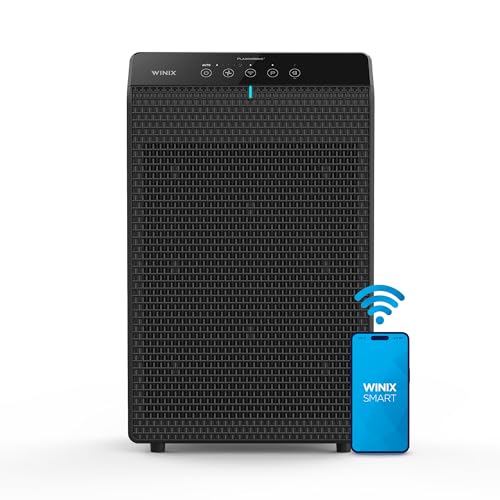
If your main complaint isn’t dust or visible fur but that specific, sharp ammonia smell that hits you when you walk into the room with the litter box, you’re dealing with a different problem than general “litter box area” odor - and it needs a purifier built around a different priority.
This is a narrower, more specific question than “best purifier for litter box smell” generally, and it’s worth being precise about which one you’re actually asking. If your complaint is more about dust and visible fur with only mild odor, our broader pillar guide and its washable-pre-filter pick is probably the better fit. This guide is for the specific case where ammonia itself - not dust - is the thing you’re trying to solve.
Why ammonia is a harder problem than dust
Ammonia is a gas, not a particle. HEPA filtration works by physically trapping particles as air passes through a dense mesh of fibers - it’s extremely effective for dust, dander, and pollen, and does essentially nothing for gas-phase odor compounds like ammonia. The only thing that removes ammonia from air is adsorption onto activated carbon, and the amount of carbon (and how the air is directed through it) determines how much odor a unit can actually handle before the filter saturates.
A lot of purifiers list “activated carbon” on the box while using a thin, carbon-dusted pre-filter as essentially an afterthought to the HEPA stage. The Winix 5520 is built the other way: its AOC (Advanced Odor Control) filter is sized as a dedicated, substantial carbon stage, which is what an ammonia-heavy litter box room actually needs, rather than just general dust reduction.
There’s a reason this distinction matters more for cat pee smell than for almost any other pet-odor scenario we cover on this site: ammonia concentration from cat urine is generally sharper and more concentrated than the odor compounds involved in general dander or “wet dog” smell, particularly in multi-cat homes or homes where scooping happens less than daily. A carbon stage that’s merely adequate for general room freshening can be quickly overwhelmed by a genuinely heavy ammonia load, which is exactly the failure mode described in lower-starred reviews of HEPA-focused purifiers used for this specific problem.
What to know about PlasmaWave before you buy
The 5520 includes an optional ionizing feature called PlasmaWave, which can be switched off entirely in the unit’s settings. If you’re in a household where you’d rather avoid ionizing technology altogether (for example, if you also have a bird - see our bird safety guide on why that matters there), the good news is this isn’t a fixed design choice: the unit runs with PlasmaWave permanently off and still gives the odor control the carbon filter is designed to provide.
Winix markets PlasmaWave as an additional layer of odor and particle treatment, and some owners do report running it on without issue. But because the feature’s ion-generation mechanism carries the same category of question as any ionizer (see our ionizer and ozone breakdown for the full reasoning), and because the AOC carbon filter is doing the actual heavy lifting on ammonia regardless of whether PlasmaWave is on, the simplest approach for most households is to treat PlasmaWave as optional and skip it rather than as a feature worth seeking out.
The 2/3 rule for this model
AHAM-verified CADR of 253 CFM (Winix’s own site lists 243) works out to a 2/3-rule room ceiling of roughly 380 sq ft - close to the registry’s own 392 sq ft rating, and comparable to the Levoit Vital 200S we recommend as our overall pillar pick. The meaningful difference between the two isn’t room coverage; it’s how each brand prioritizes carbon capacity for odor versus a washable pre-filter for hair.
What it costs to run
| Model | CADR (CFM) | 2/3-rule room ceiling | Filter cost/yr | Filter life |
|---|---|---|---|---|
| Winix 5520 | 253 | ~380 sq ft | ~$80 | 12 months |
| Levoit Vital 200S-P | 250 | ~375 sq ft | $50-100 | 6-12 months |
The Winix filter costs slightly more per unit but lasts up to twice as long, which works out to a comparable - sometimes lower - effective annual cost, depending on how heavily you’re running it.
What owners specifically report about ammonia smell
- “The smell is just gone, not masked” is a recurring, specific phrase across reviews - a meaningful distinction from products that rely on fragrance to cover odor rather than removing the compound from the air.
- Multi-cat households report the clearest before/after, likely because a heavier ammonia load makes the difference between a HEPA-focused unit and a carbon-focused one more obvious.
- PlasmaWave can be left off permanently. The carbon and HEPA stages keep working without it, so odour control does not depend on running an ionising feature continuously.
- The 12-month filter life holds up in lighter-use single-cat homes, but multi-cat owners more commonly report replacing closer to 8-10 months to keep ammonia control at full strength.
- Owners specifically compare it favorably to scented litter and sprays they’d previously tried and abandoned, often describing this as the first approach that addressed the smell rather than adding a competing one on top of it.
- A faint “new unit” smell in the first day or two is normal for new electronics and fresh filter material, and it fades as the carbon stage settles in.
A quick gut-check before you buy
If you’re deciding between this and a more general HEPA-focused purifier, ask yourself which of these two complaints better describes your situation: “the room smells sharply of ammonia” points toward this model’s dedicated carbon design; “there’s visible fur and dust, and the room smells generally stale” points toward a HEPA-forward pick like the one covered in our pillar guide. Many households genuinely have both problems and would do well with either - the distinction matters most when one complaint clearly dominates the other.
For the full deep-dive on this exact unit - PlasmaWave, noise by fan speed, the complete honest-downsides list - read our Winix 5520 review. If you want the two models compared directly, side by side, on every spec that matters, see Levoit Vital 200S vs. Winix 5520.
Honest downsides
- The PlasmaWave feature, while switchable, means there’s an extra setting to check and confirm is off if avoiding ionizing tech matters in your household.
- At the AHAM-verified 253 CFM, it’s not the right choice for a room much larger than roughly 380 sq ft - size up rather than expecting it to stretch further.
- Some owners note the unit’s footprint is slightly bulkier than similarly rated competitors, worth factoring in for tight spaces.
- There’s no washable pre-filter stage the way the Levoit Vital 200S has, meaning cat hair management relies more on the standard filter replacement schedule rather than a quick sink rinse - worth knowing if heavy shedding is also a concern alongside the ammonia smell.
What to actually expect in the first few weeks
Based on the timeline owners describe, here’s a realistic expectation curve rather than an immediate before/after: a noticeable reduction in the sharpest ammonia smell within the first 24 to 48 hours of correct placement, continued improvement over the following week as the carbon filter reaches its steady-state absorption rate, and then a stable, consistent level of odor control from that point on - provided scooping frequency and litter type stay consistent on your end. If the room still smells strongly after a full week of correct placement, it’s worth double-checking room size against the 2/3-rule ceiling before assuming the unit isn’t working.
Related reading
- For general litter box smell (not specifically ammonia-heavy), our pillar guide is Best Air Purifier for Cat Litter Smell.
- For the broader question of what purifiers can and can’t do for pet odor generally, read Do Air Purifiers Help with Pet Odor?.
- Still deciding if it’s worth buying one at all? Are Air Purifiers Worth It If You Have Pets? breaks down the actual cost-benefit math.
Browse every guide in this silo on the cat air purifier hub.
Frequently asked questions
Why does cat pee smell need a different purifier than general litter dust?
Ammonia is a gas-phase odor compound, not a particle - HEPA filters (which trap particles) do very little to remove it. What matters is a thick, dedicated activated carbon stage, which is why the spec to check is carbon filter design, not just the HEPA or CADR rating.
Does the Winix 5520's PlasmaWave feature help or is it a gimmick?
PlasmaWave is an optional ionizing feature that can be switched off entirely, and many owners specifically report running the unit with it off and still getting strong odor control from the AOC carbon filter alone. If ionizing features are a concern in your household, this unit lets you disable it rather than being locked into it.
How often does the carbon filter need replacing for a strong cat pee smell?
Winix lists roughly 12 months for typical use. In homes with a heavier ammonia load (multiple cats, infrequent scooping), owners more commonly report replacing it closer to 8-10 months to maintain full odor control.
Will it work on old, already-set-in urine smell in carpet?
No - that smell is embedded in the carpet fibers or padding, not circulating in the air. An air purifier addresses ongoing airborne ammonia; set-in stains need an enzymatic cleaner or professional carpet cleaning at the source.