Levoit Vital 200S vs. Winix 5520: The Registry Number Is Higher Than the Box Says for Both
The default pick if you're not sure which problem you actually have
4.6/5Best for: hair, dander, and general litter box freshness across one or two cats. If ammonia specifically is your problem, keep reading - the Winix 5520 is built for exactly that.

These are the two purifiers we recommend most often on this site, and a lot of people comparing purifiers narrow it down to exactly these two before buying. Between them, the difference is less about quality and more about which problem you are solving, and the honest answer to “which one is better” is that it depends entirely on which specific problem you’re solving. Full individual breakdowns are in our Vital 200S review and Winix 5520 review - this piece puts them side by side on the decision that actually matters.
The one-question test
Before getting into specs, ask yourself which of these two complaints better describes your household: “there’s visible hair and dust, and the room smells generally stale” points toward the Vital 200S. “The room smells sharply of ammonia, specifically near the litter box” points toward the Winix 5520. Many households genuinely have some of both - the distinction matters most when one complaint clearly dominates the other.
Levoit Vital 200S-P
Washable pre-filter, higher CADR, the better fit for hair and general dander.
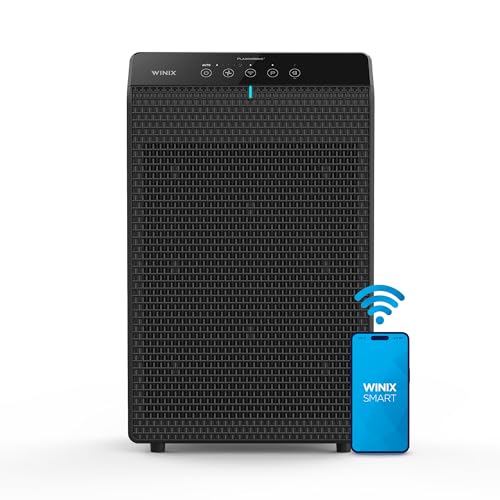
Winix 5520
Carbon-first AOC filter, the better fit for ammonia-heavy litter box odor.
Why the mechanism actually differs, not just the marketing
Both units use a real activated carbon stage, so it’s not that one “has odor control” and the other doesn’t. The difference is emphasis. The Vital 200S’s design priority is a washable pre-filter stage that keeps hair from clogging the HEPA and carbon layers underneath it - the pattern that shows up most in its reviews is about maintenance ease in shedding-heavy homes. The Winix 5520’s AOC carbon filter is sized as a primary filtration stage specifically for odor, which is the pattern that dominates its reviews almost to the exclusion of hair-and-dander comments.
Neither approach is “wrong” - they’re solving for different dominant complaints, and the filter design of each reflects that split cleanly: a washable pre-filter on one, a dedicated carbon stage on the other. Pick the Vital 200S for ammonia and it is the wrong unit; pick the 5520 for heavy shedding and it is the wrong unit review focused heavily on the pre-filter.
Side-by-side on the numbers
| Levoit Vital 200S | Winix 5520 | |
|---|---|---|
| CADR (AHAM-verified) | 250 CFM | 253 CFM |
| 2/3-rule room ceiling | ~375 sq ft | ~380 sq ft |
| Noise range | 24-54 dB | 27-55 dB |
| Pre-filter | Washable | Non-washable |
| Filter life | 6-12 months | ~12 months |
| Filter cost/yr | $50-100 | ~$80 |
On raw CADR and room coverage, the two are functionally tied - this isn’t a case where one is “bigger.” The real decision points are the pre-filter (washable vs. not) and the filter-life/cost tradeoff, both covered below.
What it costs to run
| Model | CADR (CFM) | 2/3-rule room ceiling | Filter cost/yr | Filter life |
|---|---|---|---|---|
| Levoit Vital 200S-P | 250 | ~375 sq ft | $50-100 | 6-12 months |
| Winix 5520 | 253 | ~380 sq ft | ~$80 | 12 months |
The two filters are priced within about $30 of each other, but on different schedules: Levoit rates the Vital 200S for 6 to 12 months depending on load, while Winix rates the 5520 for a full 12. At the low end of Levoit’s range, the Vital 200S is the cheaper of the two to run per year; at the high end - more typical in a multi-cat or heavy-shedding home - it can cost more than the Winix. Check which end of that range your household is likely to land in before assuming either number is the one you’ll actually pay.
What owners actually say, side by side
Vital 200S owners talk about the pre-filter constantly - rinsing hair off in the sink instead of buying a replacement filter every few weeks - and about placement near a litter box or favorite cat spot mattering more than fan speed.
Winix 5520 owners talk about ammonia specifically - “the smell is just gone, not masked” is a recurring, specific phrase - and about the PlasmaWave ionizing feature being simple to switch off without losing the odor control the carbon filter provides.
Where the two groups overlap: both mention multi-cat households needing more frequent filter attention than the manufacturer’s stated range, and both mention noise being a non-issue on lower speeds but noticeable in a quiet bedroom on the top setting.
Noise, side by side
The Vital 200S’s 24-54 dB range and the Winix 5520’s 27-55 dB range are close enough that neither has a clear edge - both are easy to ignore on low, a steady background hum in the middle, and more noticeable on the top speed in a small, quiet room. If noise specifically is a deciding factor for you, it isn’t a reason to choose one over the other; the deciding factors are the pre-filter and the odor-control emphasis covered above.
If you have a bird in the house too
This is worth a dedicated mention because it changes the calculus for a meaningful slice of readers. Both units are mechanical HEPA-plus-carbon designs with no forced ionizing mode, which is the baseline requirement we cover in our bird safety guide - so both are acceptable starting points from a safety standpoint. Where it matters is the Winix 5520’s optional PlasmaWave feature: it’s switchable off, and reviews consistently show owners doing exactly that, but it’s one more setting to double-check in a household where avoiding ionizing tech matters. The Vital 200S has no equivalent feature to switch off in the first place, which is a small but real point in its favor if you’d rather have one less thing to verify.
Honest downsides - both units
- Vital 200S: no dedicated odor-first design - the carbon stage is solid but not the primary emphasis the way it is on the Winix. Also, the washable pre-filter still requires real, regular maintenance; it’s not a “maintenance-free” claim.
- Winix 5520: no washable pre-filter, meaning hair and dander management relies more on the standard replacement schedule. The optional PlasmaWave feature is an extra setting to check if avoiding ionizing tech matters to your household.
- Both: neither is a whole-house solution - performance is strongest in the room each unit is placed in, and both need correct sizing against the 2/3 rule to perform as reviewed.
Multi-cat households: does the calculus change?
Somewhat. Both units need more frequent filter attention in a multi-cat home than the manufacturer’s stated range suggests, but the specific bottleneck differs. On the Vital 200S, it’s the washable pre-filter needing weekly rather than monthly rinsing as hair load increases. On the Winix 5520, it’s the AOC carbon filter saturating faster under a heavier combined ammonia load, pushing replacement closer to 8-10 months instead of the full 12. Neither becomes a worse purchase in a multi-cat home - both scale reasonably - but it’s worth going in expecting the maintenance rhythm to tighten up rather than assuming the single-cat numbers will hold.
Which one should you actually buy?
Based on the patterns across both review sets: if your complaint is genuinely mixed - some hair, some odor, nothing dominant - the Vital 200S is the safer general-purpose default, mainly because the pre-filter maintenance story is easier to live with long-term. If ammonia is clearly your dominant, specific complaint, the Winix 5520’s carbon-first design is worth the tradeoff of a less convenient pre-filter situation. And if you have both a heavy-shedding situation and a strong ammonia problem in different parts of the house, running one of each - Winix near the litter box, Vital 200S in the main living space - is a pattern that shows up often enough in reviews to be a legitimate option, not just an upsell.
Alternatives worth knowing about
- If you’re comparing across the full Levoit lineup rather than just this one model, our three-way Levoit comparison covers the Core 300 and Vital 100S alongside the Vital 200S.
- For ammonia specifically, our dedicated air purifier for cat pee smell guide goes deeper on why carbon filter design matters more than CADR for that exact problem.
- For general litter box smell as a broader topic, our pillar guide covers placement and sizing in more depth.
Browse the full cat air purifier hub for every guide in this silo.
Frequently asked questions
Which one should I buy if I only have one cat and no strong ammonia smell?
The Vital 200S - its washable pre-filter is the more useful feature when hair and general dander, not ammonia specifically, are the main complaint.
Which one should I buy if litter box smell is my main complaint?
The Winix 5520. Its AOC carbon filter is sized as a primary filtration stage rather than an afterthought, which is the detail that matters most for ammonia specifically - a gas-phase compound that HEPA filtration alone does very little to address.
Is one meaningfully better built or more reliable than the other?
Neither maker publishes failure-rate data, so we cannot claim a reliability gap in either direction. The meaningful differences are in filter design (washable vs. not) and filtration priority (hair/dander vs. odor), not build quality or longevity.
Can I just buy both?
It's a reasonable approach in a household with both a strong odor complaint and a heavy-shedding situation - some owners specifically describe running a Winix 5520 near the litter box and a Vital 200S in the main living area. It's a bigger upfront and ongoing cost, so it's worth confirming you actually have both problems before doubling up.